Why Every New Homes Development Needs AI Video Marketing
How new homes developers use AI video marketing to sell off-plan, launch phases faster and keep campaigns fresh — from CGI animation to plot-by-plot social content.
By The ImageMotion AI Team · 23 April 2026
Quick answer
New homes developments need AI video marketing because sales campaigns run for months or years and demand a constant supply of fresh content across plots, phases and platforms. AI image-to-video turns CGIs, show home photography and progress shots into cinematic clips in minutes, letting developers market off-plan with motion from day one and refresh campaigns continuously without repeat filming costs.
Key takeaways
- New homes campaigns need sustained content over months or years — a single launch film is never enough.
- AI video animates CGIs and renders, so off-plan marketing can lead with motion before anything is built.
- Show home photography becomes a library of social clips, ad creative and email content.
- Progress photography turned into video keeps buyers engaged and reservations warm through the build.
- Per-clip pricing means every plot, phase and house type can have its own video.
A new homes development is not a listing; it is a campaign. Where a resale property might be marketed for eight weeks, a development sells for eighteen months to five years, across multiple phases, house types and buyer audiences. The content demands are relentless — and yet most schemes still launch with one CGI fly-through, a photo gallery and a site plan, then market on those same static assets until the final plot completes.
AI video changes what is economically possible for that long campaign. By generating cinematic motion from the CGIs, show home photography and progress shots a developer already produces, AI image-to-video gives sales and marketing teams a continuous supply of fresh video at per-clip prices. Here is why that matters, and how to use it across the life of a scheme.
The new homes marketing problem
Three structural issues make development marketing harder than resale marketing:
The product does not exist yet. Off-plan sales ask buyers to reserve a home they cannot visit. Everything rests on how vividly the marketing makes the finished home feel real — which is why developers invest heavily in CGI in the first place.
The campaign outlasts the content. Assets commissioned at launch feel tired by phase two. Refreshing a fly-through or re-shooting film costs thousands each time, so campaigns limp on with stale creative while sales rates slow.
The audience is fragmented. First-time buyers on Instagram and TikTok, downsizers on Facebook, investors on portals and LinkedIn — each expects platform-native content, and increasingly that means vertical video. UK transaction data published on GOV.UK shows how sensitive demand is to timing and sentiment; marketing that stays fresh through the cycle protects the sales rate the appraisal assumed.
Video answers all three — motion makes unbuilt homes tangible, and platforms reward it with reach (Meta reports video is around half of time spent on Facebook and Instagram). The barrier has always been the cost of producing enough of it. That is the barrier AI removes.
From CGI to cinematic: marketing before the build
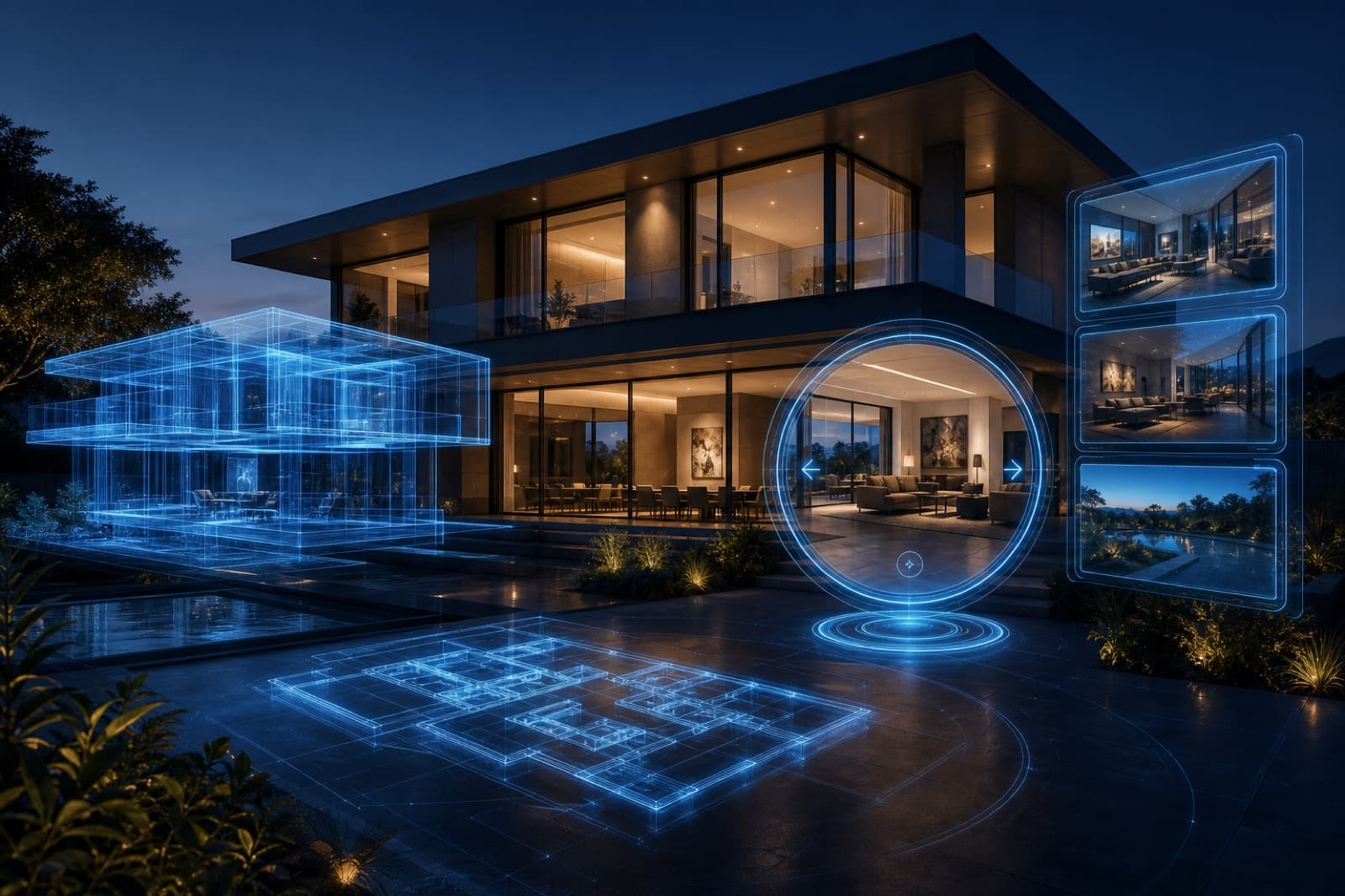
The most distinctive advantage for developers is that AI video works from renders as well as photographs. Upload a high-quality exterior CGI and the model generates believable camera motion — a slow push towards the front elevation, a lateral drift along the street scene, parallax between planting and brickwork. The still render becomes what feels like drone footage of a finished development.
Practical uses before a brick is laid:
- Launch teasers — animated CGIs announcing the scheme, coming-soon dates and early-bird registration.
- House-type features — one clip per house type, built from the plot CGIs, for the website and social rotation.
- Street scene reveals — animated masterplan visuals that convey the feel of the finished neighbourhood.
- Interior CGIs in motion — kitchen and living space renders with gentle push-ins that read as show home footage.
A visualisation studio fly-through remains a superb hero asset for the marketing suite. But at a few pounds per clip, AI generation means the fly-through no longer has to carry the entire campaign alone — every plot release, price update and incentive push can have its own fresh motion content. Our dedicated new homes video marketing page shows this workflow end to end.
The show home moment
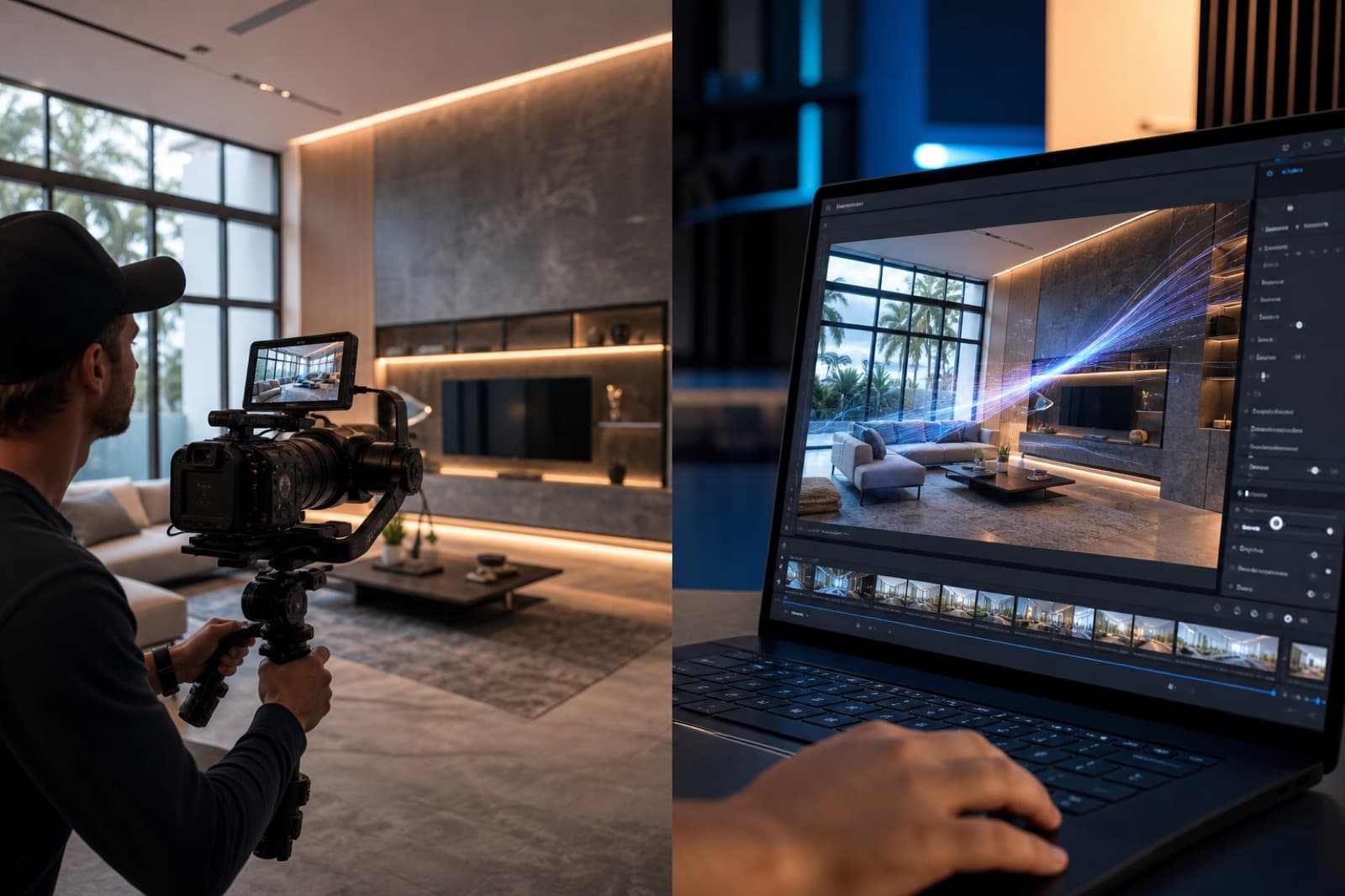
When the show home opens, professional photography follows — and that shoot becomes a video library. Each photo generates a clip: the kitchen push-in, the master suite drift, the dressed living space with light pouring in. From one photography session, a sales team gets:
- A show home launch film assembled from room clips
- Weeks of individual room Reels for Instagram and Facebook
- Ad creative for the reservation campaign
- Email content for the registration list
Because generation takes minutes (the workflow is identical to the one in how to turn property photos into video in under five minutes), the show home content can be live on social the same day the photography arrives.
Keeping the campaign alive: progress and phases
Mid-campaign is where most development marketing goes quiet — and where buyers waiting on completions go cold. AI video keeps the rhythm going at negligible cost:
- Build progress updates. Monthly site photography becomes motion content: foundations to frame to roof. Progress video reassures exchanged buyers and creates urgency for hesitant ones.
- Phase releases. Each release gets launch treatment — new CGI clips, updated availability, fresh ad creative — rather than a reworded caption on old imagery.
- Seasonal refreshes. The same street scene animated from autumn and spring photography keeps the feed from fossilising.
- Local area content. Clips of the high street, station, schools and green space sell the location alongside the homes — often the deciding factor for relocating buyers.
| Campaign stage | Source imagery | AI video output | |---|---|---| | Pre-launch | Exterior and interior CGIs | Teasers, house-type clips, registration ads | | Launch | CGIs + masterplan visuals | Launch film, plot features, paid social | | Show home open | Professional photography | Room Reels, tour film, ad refresh | | Mid-campaign | Progress + seasonal shots | Updates, phase launches, retargeting creative | | Final plots | Best photography + sold content | Urgency campaigns, last-remaining clips |
Paid advertising: where the numbers compound
Development marketing leans on paid social more than any other property sector — registration campaigns, open-day pushes, incentive promotions. Video creative is the highest-leverage upgrade available: it typically delivers cheaper reach and stronger click-through than static CGI cards, and vertical clips unlock Reels and Stories placements that static creative fills poorly.
Because AI generation is so cheap, teams can also do what static budgets never allowed: creative testing at volume. Run the kitchen clip against the facade clip against the street scene; let the platform find the winner; regenerate variations of it. The full method — audiences, placements, measurement — is covered in how AI property videos improve Facebook and Instagram advertising.
A playbook for sales and marketing teams
- Audit existing assets. Gather every CGI, render, show home photo and site shot. Each is potential video.
- Build the launch set. Generate clips for every house type and the key street scenes via ImageMotion AI; export portrait for social, landscape for the scheme website and portals.
- Set the weekly rhythm. One plot or house-type Reel, one lifestyle or local clip, plus a monthly progress update. Fifteen minutes a week per development.
- Refresh ads monthly. Rotate new clips into Meta campaigns before frequency fatigue sets in.
- Equip the sales suite. Clips on the reservation-desk screens and in follow-up emails to visitors — the same content that fills the feed closes in the suite.
The wider strategic context — why motion is becoming the default for all property marketing — is in our articles on AI video vs traditional videography ROI and the future of property marketing, and the developer-specific fundamentals are summarised in our guide to AI video for new homes developers.
Case pattern: a 120-unit scheme, phase by phase
To make the playbook concrete, consider how the content programme runs across a typical 120-home scheme selling over thirty months.
Months 1–3 (pre-launch). The visualisation pack arrives: eight exterior CGIs, six interiors, a masterplan visual. Each becomes an animated clip; the registration campaign launches with a rotating set of five, refreshed fortnightly by regenerating from different renders. Registration ads with motion creative build the early-bird list while the marketing suite is still a portacabin.
Months 4–9 (launch and first releases). Launch weekend is supported by house-type clips for each released plot style. Every price release and incentive gets fresh creative rather than a reworded caption. The sales team sends WhatsApp clip sets to every suite visitor within an hour of their appointment — the follow-up that gets replies.
Months 10–18 (show home era). Show home photography generates the campaign's strongest asset library: room clips feed a weekly social rhythm, and the show home tour sequence becomes the hero of the scheme website. Progress photography — now genuinely interesting as streets take shape — runs monthly.
Months 19–30 (momentum and closure). Completed street scenes photographed in golden hour replace CGIs across all creative, visibly signalling "this is real now". Final-phase urgency campaigns run on last-remaining clips, and sold-out house types become social proof content for the developer's next scheme.
Total video output across the campaign: several hundred clips. Total cost at per-clip pricing: less than one traditional film shoot. That arithmetic — not any single tactic — is why AI video fits development marketing so naturally.
Coordinating agencies, developers and photographers
Development marketing usually involves three parties, and the video workflow slots into each seam:
- Marketing agencies managing a developer's campaigns can standardise the clip pipeline across every scheme they run: assets in, motion out, creative refreshed monthly, with per-clip pricing that maps cleanly onto client billing.
- Developers' in-house teams get independence from production schedules — a price change on Friday afternoon can have fresh ad creative by Friday teatime.
- Photographers serving development clients can deliver show home and progress shoots with motion sets included, the premium-package model described in our photography tips article.
Whoever holds the workflow, the principle is the same: the scheme's existing visual assets are an under-exploited video library, and the cost of exploiting it has fallen to almost nothing.
Measuring the programme
Development marketing answers to a sales rate, so the video programme should report against it. Four numbers keep the content effort honest: registrations per week (the top of the funnel paid social feeds), appointment bookings from the registration list (what fresh creative reactivates), cost per registration in Meta campaigns (where video versus static shows up first), and reservation conversion among suite visitors who received follow-up clip sets versus those who did not. Most schemes see the advertising number move within the first month of switching to video creative; the follow-up effect appears in the sales director's weekly report soon after. Set the baseline before the switch, and the programme justifies itself in the language appraisals are written in.
Conclusion
A development campaign lives or dies on sustained momentum, and momentum needs content. AI video turns the assets a developer already commissions — CGIs, show home photography, progress shots — into a continuous stream of cinematic marketing, from pre-launch teasers to final-plot urgency campaigns, at a cost that disappears inside any scheme's budget.
Test it with the assets on your desk today: upload a house-type CGI or show home photo to ImageMotion AI and watch it move. The examples show what developers are producing, and pricing shows why every plot can now afford its own video.