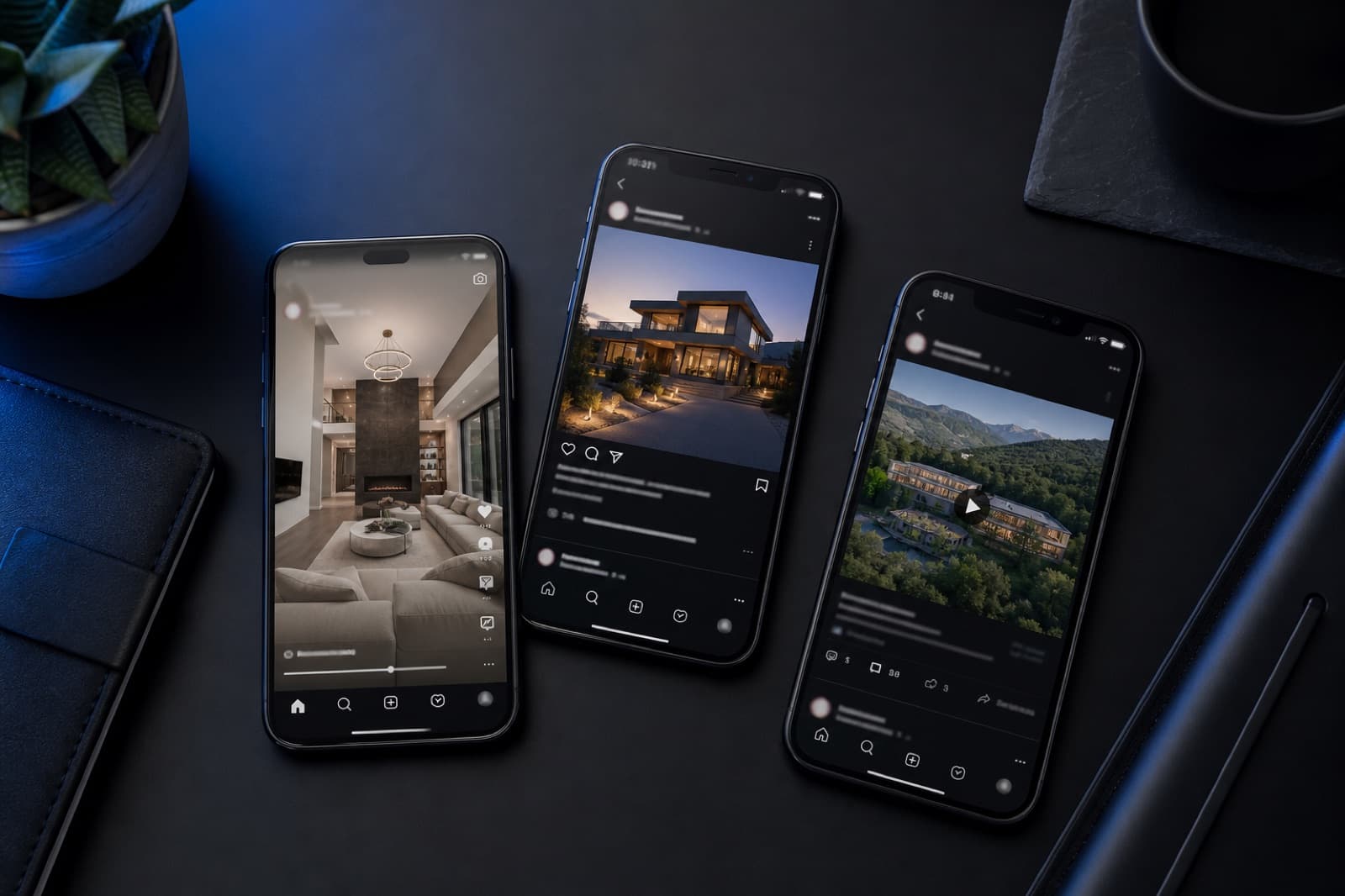
How AI Property Videos Improve Facebook and Instagram Advertising
Why video creative outperforms static images in Meta property ads, and how AI-generated property videos cut cost per lead — campaign structures, formats and testing frameworks included.
By The ImageMotion AI Team · 5 March 2026

Quick answer
AI property videos improve Facebook and Instagram advertising because video creative typically earns cheaper reach, stronger attention and lower cost per lead than static images — and vertical video unlocks Reels and Stories placements that static creative fills poorly. AI generation makes it affordable to give every campaign fresh video and to test multiple creatives per audience instead of running one static ad until it fatigues.
Key takeaways
- Video creative consistently outperforms static images in Meta property campaigns on attention and cost per result.
- Vertical 9:16 video unlocks Reels and Stories placements where static ads underperform or letterbox.
- AI generation enables real creative testing — several video variants per campaign for the price of none.
- The three campaign types that benefit most: listing lead generation, vendor valuation campaigns and development registrations.
- Refresh creative every few weeks to beat ad fatigue; AI makes refreshes a five-minute job.
Most estate agency Facebook ads are a photo, a headline and hope. They compete in the most video-saturated environment in marketing — a feed engineered around Reels — armed with a static image. The result is predictable: high frequency, rising costs and campaigns quietly switched off after a month.
The fix is not more budget; it is better creative. Video is the format Meta's platforms are built around, and AI image-to-video means every agency can now produce it from the listing photos it already owns. This article covers why video changes ad economics, which campaigns to run, and how to structure testing so the numbers keep improving.
Why video changes Meta ad performance
Three mechanisms, all compounding:
Attention is the auction's hidden currency. Meta's delivery system rewards ads that people engage with — watching, dwelling, clicking — by showing them to more people for less money. Video holds attention longer than a static image almost by definition, and Meta has said video accounts for roughly half of all time spent on Facebook and Instagram. Better engagement signals feed back into cheaper delivery.
Placements favour motion. Reels and Stories are video-native, full-screen, sound-on environments. A static image in these placements either letterboxes awkwardly or is simply outcompeted. Vertical video creative makes your campaign eligible for the fastest-growing placements at full quality — the same dynamic that drives organic strategy in our social media guide for estate agents.
Motion suits the product. A photograph shows a kitchen; a slow push-in makes a viewer feel they are walking into it. For an emotionally driven, high-consideration product like a home, those extra seconds of imagined occupancy are exactly what an ad needs to buy. Research from Google tells the same story across formats: video mediates ever more of high-consideration purchase journeys.
The historic barrier was supply: filmed creative cost hundreds of pounds per listing, so campaigns ran one static image until it fatigued. That barrier is gone — the cost comparison is in AI property videos vs traditional videography.
The three campaigns that benefit most
1. Listing promotion (buyer leads)
Goal: enquiries and viewings for a specific property. Creative: a 6–15 second clip of the property's strongest feature — usually the kitchen, garden or a twilight exterior — with price, location and a clear call to action in the copy. Targeting: a radius or postcode set around the property, broad demographics; let the creative and Meta's optimisation find the buyers.
This is the workhorse campaign. Because AI clips cost a few pounds, even a £250k listing justifies its own ad — not just the £1m ones.
2. Vendor valuation campaigns (instruction leads)
Goal: valuation requests from homeowners considering a sale. Creative: just-sold stories ("Sold in 11 days, three offers"), local market clips, and marketing showcases — the property clips themselves double as proof of how you would market the viewer's home. Targeting: your core postcodes, homeowner-skewing ages, ongoing rather than burst.
This campaign is where video creative works twice: it wins attention and demonstrates the very marketing capability the vendor is buying. It is the paid-media counterpart of the tactics in 15 ways estate agents win more instructions with AI video.
3. Development registration campaigns
Goal: early-interest lists for new homes schemes. Creative: animated CGIs before build, show home clips after — a continuous creative pipeline through the campaign's life, detailed in why every new homes development needs AI video marketing. Targeting: first-time-buyer or upsizer profiles by scheme, wider radii than resale campaigns.
Development campaigns run for months, which makes creative refresh capability — AI's core advantage — decisive.
Formats and specs that matter
| Placement | Ratio | Length | Notes | |---|---|---|---| | Reels (FB + IG) | 9:16 | 6–15 s | Highest-growth placement; design for sound-off first | | Stories | 9:16 | 6–15 s | Full-screen; keep text within safe zones | | Feed (FB + IG) | 1:1 or 4:5 | 6–30 s | Square travels well across both apps | | In-stream / others | 16:9 | 15–30 s | Lower priority for property |
Practical rules:
- First second wins or loses. Open on the strongest frame — the twilight facade, the light-flooded kitchen. No logos, no title cards.
- Design for silence. Most feed impressions are muted; the motion and a short text overlay must carry the message.
- One property, one message. Multi-property carousels have their place, but single-listing video with a single call to action is the reliable performer.
- Generate all ratios at once. ImageMotion AI exports portrait, square and landscape from one generation, so full placement coverage is the default, not extra work.
Creative testing: the practice AI unlocks
With filmed creative, testing was theoretical — nobody re-films a house to try a different opening shot. With generation costing pennies and minutes, proper testing becomes routine:
- Generate three to five variants per campaign: different rooms, different motion styles, different opening frames.
- Run them in one ad set with Meta's dynamic creative or as separate ads with even budgets.
- Read the diagnostics after 3–4 days: hook rate (3-second views ÷ impressions) tells you about the opening frame; hold rate tells you about the clip overall; cost per result settles the argument.
- Kill the losers, clone the winner with new variations, and repeat.
Expect surprises. Kitchens beat exteriors for some stock; gardens win in spring; twilight clips dominate premium audiences (see the luxury video ideas for that end of the market). The point of testing is that you stop guessing.
Beating fatigue: even winning creative decays as frequency climbs. Refresh every two to four weeks — a new clip from a different photo of the same property is a five-minute job with the photos-to-video workflow, and it resets the fatigue clock.
Measurement that keeps you honest
Track four numbers, compare against your static-era benchmarks, and give tests two weeks minimum:
- Cost per result — lead, click or landing-page view, depending on campaign goal.
- Hook rate — under 20% suggests a weak opening frame; swap it.
- Hold rate — completion percentage; short clips should finish strong.
- Frequency — above 3–4 in a local campaign, refresh the creative.
Attribute properly at the business end too: ask every valuation booking and applicant where they saw you. Paid social effects show up in that answer faster than in any dashboard. For the wider evidence base on video's advantage, our 2026 property marketing statistics roundup collects the numbers.
A starter campaign, step by step
For an agency that has never run video ads, here is a complete first campaign that can be live within an hour:
- Choose the listing. Pick a property with strong photography and broad appeal for your area — the three-bed family home usually beats the unusual stock for a first test.
- Generate the creative. Upload the six best photos to ImageMotion AI and generate clips; download the portrait and square versions. Total time: about five minutes, per the standard workflow.
- Build the campaign in Meta Ads Manager. Objective: leads or traffic to the listing page. One ad set, radius targeting around the property (3–5 miles in urban areas, wider in rural), ages 25–65+, no interest targeting — let delivery optimise.
- Load three video ads. Different opening rooms, same copy structure: hook line, price and location, call to action. Set a £5–£10 daily budget.
- Leave it alone for four days. Early performance is noisy; resist the urge to edit, which resets learning.
- Then read the diagnostics. Kill the weakest ad, note which opening frame won the hook-rate contest, and either scale the winner or clone it with a variation.
Run this once and you will have your own benchmark numbers — hook rate, cost per click, cost per lead — against which every future campaign and every static-versus-video argument can be settled with data rather than opinion.
Beyond the listing: retargeting and lookalikes
Once basic campaigns run smoothly, two intermediate moves materially improve returns:
Retarget video viewers. Meta lets you build audiences from people who watched a percentage of your videos. Someone who watched 75% of a property clip is a warmer prospect than any cold audience — retarget them with the follow-up: more clips of the same property, the open-day invitation, or the "similar homes" carousel. This turns every organic and paid video view into audience-building, which is another reason to post consistently (the social media playbook covers the organic side).
Build lookalikes from real outcomes. Upload your applicant or vendor-lead lists (with appropriate consent under UK data protection rules — see guidance on GOV.UK) and let Meta find similar local audiences. Vendor lookalikes fed with just-sold video creative is the highest-value pairing in agency advertising: proof-of-results content shown to people statistically resembling your past clients.
Both techniques depend on a steady supply of video creative — audiences decay and creative fatigues — which is exactly the supply problem AI generation solves.
Budgeting: what different spend levels buy
A question every principal asks, answered in rough but realistic terms for a UK branch territory with video creative doing the work:
| Monthly budget | What it supports | Realistic expectation | |---|---|---| | £100–£150 | One always-on campaign (listings or vendor) | Steady local visibility; a handful of leads monthly | | £250–£400 | Listings promotion + always-on vendor campaign | Consistent lead flow both sides; brand recall at valuations | | £500–£1,000 | Full mix + retargeting and lookalikes | Measurable share-of-voice in the territory; campaign data worth optimising |
Two notes on reading the table. First, creative quality moves results more than budget at these levels — £150 behind a strong twilight clip regularly outperforms £400 behind a static photo card, which is why the creative pipeline matters more than the media plan. Second, the vendor campaign deserves protection when budgets tighten: buyer leads follow stock, but vendor leads create stock, and video proof-of-marketing content is the strongest vendor creative there is.
Conclusion
Meta advertising rewards exactly what AI video supplies: motion that holds attention, vertical formats that fill the growth placements, and a creative pipeline cheap enough to test and refresh continuously. Agencies that upgrade from static images to AI video ads typically see the difference in cost per lead within a fortnight — and the creative advantage compounds every month the competition keeps boosting photos.
Build your first video campaign this week: pick a live listing, generate a clip set with ImageMotion AI, and run it against your usual static ad with a small budget. The examples show what ad-ready output looks like, and pricing means the test costs less than the coffee round.