AI Property Videos vs Traditional Videography: Which Delivers Better ROI?
A detailed cost and ROI comparison of AI property video and traditional videography for estate agents — real numbers, use cases, and when each approach makes commercial sense.
By The ImageMotion AI Team · 18 June 2026
Quick answer
For most property marketing, AI property video delivers a substantially better return on investment than traditional videography. AI video costs a few pounds per clip and is ready in minutes, while a filmed shoot typically costs £300–£1,500 per property and takes days to deliver. Traditional filming still wins for flagship developments and prime instructions where presenter-led storytelling justifies the outlay.
Key takeaways
- A traditional property video shoot typically costs £300–£1,500 per listing once filming, travel and editing are included.
- AI image-to-video generates cinematic clips from existing photos for a few pounds per property, with delivery in minutes rather than days.
- Video listings consistently attract more enquiries than photo-only listings, so the question is not whether to use video but how to produce it affordably.
- The strongest commercial approach for agencies is a hybrid one: AI video on every listing, filmed video reserved for prime stock.
- ROI should be measured per instruction won and per lead generated, not just per view.
Every agent has had the conversation. A vendor asks whether their home will get a video, the marketing budget says no, and the listing goes live with photos alone. Meanwhile the agency down the road is filling its Instagram feed with moving property content and quietly winning the instructions that used to be yours.
The reason video is rationed is simple: traditional property videography is expensive, slow and hard to scale. But that calculation has changed. AI image-to-video now turns the professional photos you already commission into cinematic video clips in minutes, for a few pounds per property. This article compares the two approaches head-to-head — on cost, speed, quality and, most importantly, return on investment — so you can decide where each belongs in your marketing.
Why video matters in property marketing
Before comparing production methods, it is worth restating why video deserves budget at all.
Buyers now expect motion. The National Association of Realtors has reported for years that virtually all buyers use the internet in their property search, and that listings with richer media hold attention for longer. On social platforms the shift is even starker: Meta has said that video makes up around half of all time spent on Facebook and Instagram, and both platforms' algorithms give video — particularly short vertical video — significantly more organic reach than static images.
The UK portals tell the same story. Rightmove records billions of visits a year, and listings that stand out in a crowded search results page win the click. A moving image in a feed or an email stops the scroll in a way a static photo rarely does; that is the behavioural foundation for everything else in this comparison, and it is explored in more depth in our guide to why motion content works for property marketing.
So the question facing agencies in 2026 is not whether to use video. It is how to produce it at a cost that works across the whole portfolio — and that is where AI changes the arithmetic.
What traditional property videography involves
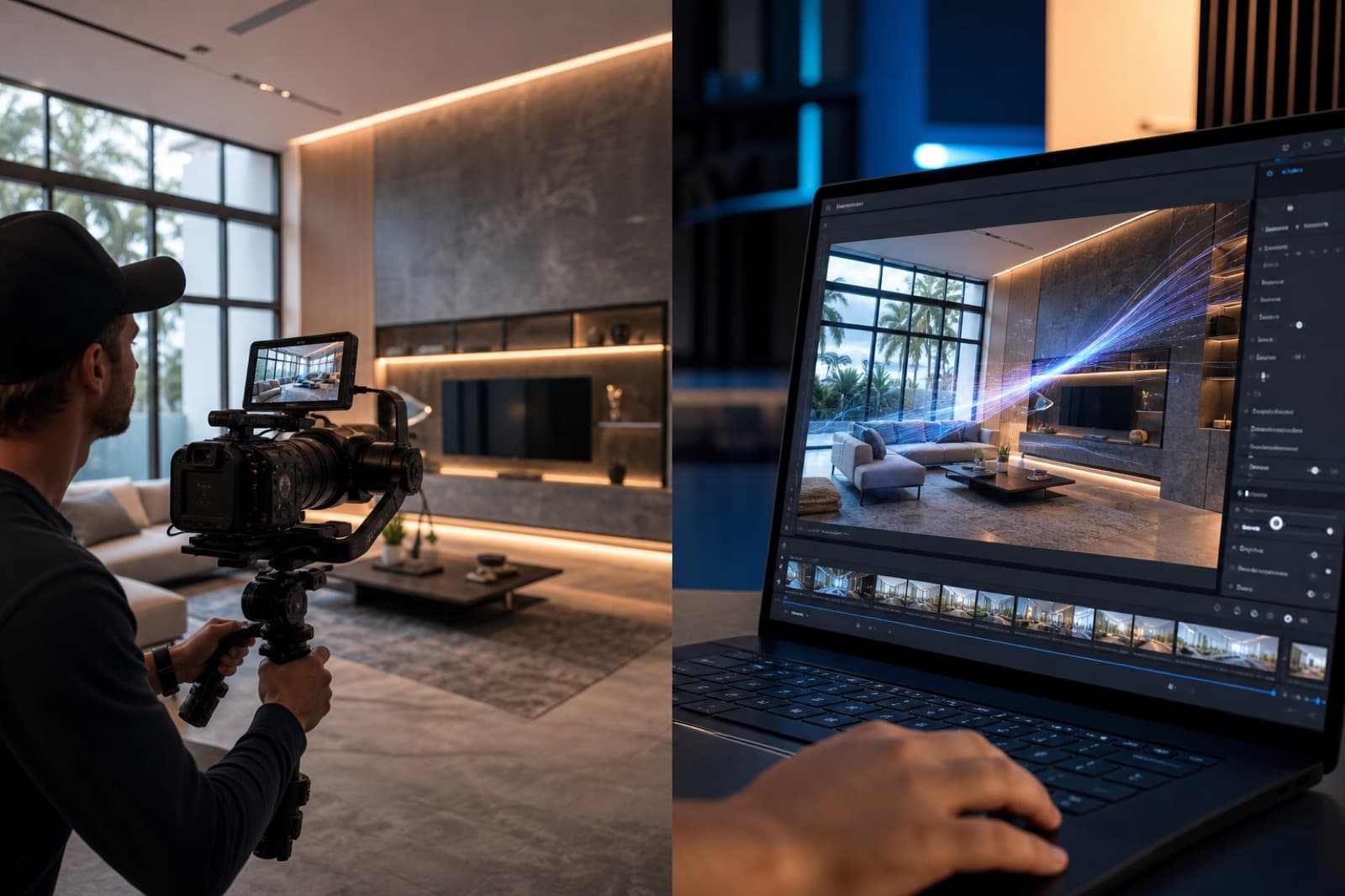
A conventional property video is a filmed production. A videographer visits the property with camera, gimbal and often a drone, shoots for one to three hours, then edits the footage into a finished film over the following days.
The typical workflow looks like this:
- Booking and scheduling — coordinating access with vendors or tenants, often one to two weeks ahead.
- The shoot — one to three hours on site, weather-dependent for exteriors and aerial work.
- Editing — colour grading, music licensing, titling and revisions, typically two to five working days.
- Delivery — one hero film, sometimes with a vertical cut for social media if specified.
Costs vary by region and specification, but in the UK a straightforward filmed walkthrough typically starts around £300, a polished agency-standard film with drone footage sits between £500 and £1,000, and presenter-led films for prime property regularly exceed £1,500. Aerial work adds regulatory overhead too: commercial drone operators must comply with Civil Aviation Authority rules published on GOV.UK, which restricts where and when exterior aerials can be captured.
None of this is a criticism. A skilled videographer produces something an algorithm cannot: presenter-to-camera storytelling, lifestyle sequences, aerial reveals timed to music. The issue is that this quality comes with a cost and lead time that make it impossible to apply to every listing.
What AI property video involves
AI property video takes a different route entirely. Instead of filming new footage, an AI model analyses a still photograph — estimating depth, structure and perspective — and generates realistic camera motion within it: smooth push-ins, lateral drifts, parallax pans. The still image becomes a cinematic clip without anyone visiting the property.
With a tool like ImageMotion AI, the workflow collapses to minutes:
- Upload the listing photos you already have.
- Choose a motion style for each image.
- Generate, preview and download clips in portrait, square or landscape.
There is no scheduling, no weather risk, no editing queue and no call-out fee. Because generation is priced per clip on pay-as-you-go credits, a full set of clips for a listing costs a few pounds. The practical steps are covered in our tutorial on how to turn property photos into video in under five minutes, and you can see finished output on our examples page.
The quality ceiling is set by your photography: sharp, well-composed professional photos produce convincingly cinematic motion. That also means AI video inherits the investment you have already made in photography rather than duplicating it.
Cost comparison: the real numbers
Here is how the two approaches compare for a typical UK agency marketing one listing:
| Factor | Traditional videography | AI property video | |---|---|---| | Cost per listing | £300–£1,500+ | A few pounds (credits) | | Booking lead time | 1–2 weeks | None | | Time on site | 1–3 hours | None | | Delivery time | 2–5 working days after the shoot | Under 5 minutes | | Weather dependency | High for exteriors and drone | None | | Revisions | Chargeable or limited | Regenerate instantly | | Social media formats | Often one format unless specified | Portrait, square and landscape included | | Scales to whole portfolio | Rarely affordable | Yes |
Now extend that across a year. An agency listing 200 properties that films only its top 10% spends roughly £15,000–£25,000 on video and still leaves 180 listings without any motion content. The same agency generating AI video on every listing spends a small fraction of that — typically less than the cost of five filmed shoots — and has video on 100% of its stock.
Measuring ROI properly
Return on investment in property marketing is not really about video views. It shows up in three places:
Instructions won
Video is a valuation-table differentiator. Research summarised by the National Association of Realtors has long indicated that a large majority of sellers favour agents who market with video. Being able to tell a vendor "every one of our listings gets a cinematic video, here are examples" is a materially stronger pitch than "we offer video on selected properties at extra cost". We cover this angle in detail in 15 ways estate agents can use AI videos to win more instructions.
Buyer and tenant enquiries
Listings with video consistently generate more engagement than photo-only listings, and video content earns more reach on social platforms, which in turn drives portal traffic. Because AI video lets you publish motion content for every listing rather than a select few, the enquiry uplift applies across the whole book rather than the top slice.
Advertising efficiency
If you run paid campaigns, video creative typically outperforms static images on cost per lead. Meta's own business guidance encourages advertisers towards short, mobile-first video, and vertical video fills the screen in Reels and Stories placements where static images cannot. Our article on how AI property videos improve Facebook and Instagram advertising goes deeper into campaign structure and creative testing.
Run the maths on any of these three measures and the pattern is the same: because the cost per AI video is so low, the return needed to justify it is trivially small. One additional enquiry, one saved photography re-shoot, or a single instruction influenced per year pays for hundreds of clips.
Where traditional videography still wins
An honest comparison has to acknowledge where a crew earns its fee:
- Flagship developments. A new homes scheme with a multi-year sales programme justifies brand-level film production alongside AI content — see why every new homes development needs AI video marketing for how the two combine.
- Prime and country-house instructions. At the top of the market, presenter-led films, lifestyle sequences and licensed aerial reveals signal the calibre of the marketing budget itself.
- Brand films. Office launches, team profiles and "why instruct us" films need real people on camera.
- Complex narratives. Where the story is the grounds, the village, the school run — footage of the wider setting still requires filming.
The right conclusion is not "AI replaces videographers". It is that the two occupy different price points and jobs. Agencies getting the best results treat filmed video as a premium product for premium stock, and AI video as the default for everything — a strategy that also gives photographers a new upsell, as we explain in best property photography tips for creating better AI videos.
The hybrid strategy in practice
A workable playbook for a typical sales and lettings agency:
- Every listing gets an AI video set generated from the professional photos on the day the listing goes live — portrait for Reels and Stories, landscape for the website and email. Tools like our estate agent video maker are built around exactly this workflow.
- Prime instructions (say the top 5–10% by fee) get a filmed video in addition, with the AI clips used as social teasers before and after the film launches.
- Lettings and commercial stock, where filming has never been economic, get AI video as standard — instantly differentiating listings in the most under-videoed part of the market.
- Valuation packs include example videos, so the marketing story is part of winning the instruction, not an afterthought.
This structure gives you video everywhere it earns money while spending filming budget only where filming genuinely adds value.
A worked example: one branch, twelve months
Numbers make the argument concrete. Take a single-branch agency listing 180 properties a year at an average fee of £3,500, currently filming its top ten instructions at £600 per shoot.
Current position. £6,000 a year on video, covering 5.5% of stock. The other 170 listings market on photos alone. Social output is sporadic because there is rarely fresh motion content to post.
AI-first position. Every listing gets a six-clip video set at launch. At typical pay-as-you-go rates that is a few pounds per listing — call it £900 a year for the entire portfolio, generated by the listing coordinator in around five minutes per property. The two or three genuinely prime instructions still get a filmed video, now supported by AI teaser clips before launch and social cutdowns afterwards.
What has to happen for this to pay for itself? Almost nothing. If portfolio-wide video influences a single additional instruction over the year — one vendor at valuation who chooses the agency because every listing demonstrably gets cinematic marketing — the fee covers the entire annual spend several times over. If better listing engagement shortens time on market by even a few days on a handful of properties, the saved price reductions and vendor goodwill are a second return on the same spend. And if the branch runs any paid social at all, the improvement in cost per lead from video creative compounds the effect month after month.
This asymmetry is the heart of the ROI case. Traditional video had to justify hundreds of pounds per property, so it was rationed to listings where the fee could absorb it. AI video has to justify pocket change per property, so the question inverts: not "which listings deserve video?" but "why would any listing go without it?"
Common objections, answered honestly
"Vendors will think AI video is cheap." The output is generated from the same professional photography a filmed shoot would start from, and the motion is deliberately cinematic rather than gimmicky. In practice vendors respond to seeing their home in motion, not to the production method — and agencies rarely find it useful to lead with the word "AI" at all. "Cinematic listing video, included on every property" is the accurate and effective description.
"Our photos aren't good enough." If the photography is not good enough for video, it is not good enough for the portal either. The fix is the same in both cases: better photography, which then pays back across every format. Our photography tips for better AI videos show that the requirements are simply good practice, not special preparation.
"We tried video and it didn't generate leads." Almost always this means a handful of videos were posted sporadically and judged within a month. Video works as a system — every listing, every week, across social, portals and email — and its largest return, instruction-winning, shows up at valuations over a quarter or two rather than in next week's enquiry count.
"The team doesn't have time." The workflow is five minutes per listing and sits naturally with whoever uploads the photos and writes the description. It is less work than ordering a board. What consumes time is filming — which is precisely what is being removed.
How to run a fair pilot
If you want evidence from your own market rather than ours, structure a simple 60-day test:
- Pick ten comparable listings as they launch — similar price band and stock type.
- Generate full video sets for five and market the other five as usual. Post the video listings' clips to social on launch day and include them in applicant emails.
- Track four numbers per listing: portal detail views, social reach on the launch post, enquiries in the first 14 days, and days to offer.
- Ask one question at every valuation during the period: "Did you see any of our marketing before booking this appointment?"
The cost of the experiment is a few pounds and an hour of setup. Most agencies do not finish the 60 days before rolling video out portfolio-wide — the launch-day social reach difference alone tends to settle the question in the first fortnight.
Conclusion
Traditional videography and AI property video are not really competitors; they are different tools priced for different jobs. But if the question is which delivers better ROI across a whole portfolio, the answer in 2026 is clear. AI video's cost is so low, and its output so fast, that it turns video from a rationed luxury into the default format for every listing — and the returns compound through more enquiries, cheaper advertising and stronger valuation pitches.
The easiest way to test the claim is with your own stock. Take the photos from a current listing, generate a set of clips with ImageMotion AI, and compare the engagement against a photo-only listing. Browse the examples, check the pricing, and see how far one shoot's worth of budget goes when every photo can move.